Have you ever noticed that the week before your period, all you want is a mountain of chocolate and salty chips? Or that during your period, you feel totally drained of energy? It’s not just in your head—it’s deeply connected to your hormones and, you guessed it, your nutrition.
What you eat has a massive impact on how you feel throughout your menstrual cycle. And the cool part is, you can use food as a tool to work with your body, not against it. This idea is sometimes called “cycle syncing,” but you don’t need to get fancy with it. It’s really just about listening to your body and giving it what it needs, when it needs it.
At CrampCare, we’re all about empowering you with knowledge to feel your best. Let’s break down how you can eat your way to a happier, healthier cycle.
The Big Picture: Key Nutrients for a Healthy Cycle
Before we get into the different phases, there are a few all-star nutrients that are your period’s best friends, all month long.
- Magnesium: This is nature’s muscle relaxer! It can be a huge help in reducing menstrual cramps. Find it in leafy greens (spinach), nuts, seeds, and dark chocolate (yes, your craving has a purpose!).
- Iron: You lose iron when you bleed, which can lead to fatigue and low energy. It’s important to replenish it. Find it in lean meats, beans, lentils, and fortified cereals.
- Omega-3 Fatty Acids: These are amazing for fighting inflammation, which is a major cause of period pain. Find them in fatty fish (salmon), walnuts, and flaxseeds.
Eating for Your Four Phases
Your cycle has four distinct phases, and your body has different needs in each one. Think of it as eating with the seasons of your cycle.
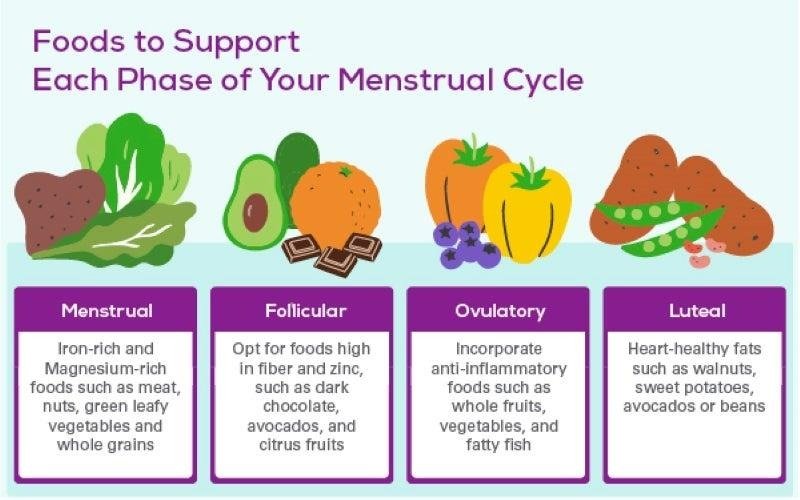
Phase 1: Menstrual (Your Period – The “Winter”)
- What’s Happening: Your uterine lining is shedding, and your hormones are at their lowest point. Energy is typically low.
- Your Food Mission: Comfort, nourish, and replenish.
- What to Eat: Focus on those key nutrients we just talked about. Warm, comforting foods are your friend here.
- Iron-rich foods to replenish what you’re losing: Think lean red meat, chicken, beans, and lentils.
- Foods high in Vitamin C to help you absorb that iron: Oranges, bell peppers, and strawberries.
- Magnesium-rich foods to help with cramps: Spinach, dark chocolate, and pumpkin seeds.
- Anti-inflammatory foods: Ginger and turmeric tea can be wonderfully soothing.
Phase 2: Follicular (Before Ovulation – The “Spring”)
- What’s Happening: Your body is preparing to release an egg. Estrogen is rising, and you’re starting to feel more energetic and vibrant.
- Your Food Mission: Keep it fresh, light, and energizing.
- What to Eat: Your body is building, so focus on fresh, vibrant foods.
- Lean proteins and plant-based proteins like tofu and edamame.
- Fresh, colorful vegetables and sprouted grains.
- Healthy fats like avocado and nuts.
Phase 3: Ovulatory (Ovulation – The “Summer”)
- What’s Happening: An egg is released! Estrogen is at its peak, and you’re likely feeling your most social, confident, and energetic.
- Your Food Mission: Support your liver and maintain energy.
- What to Eat: You need fiber to help your body process that peak in hormones.
- Lots of fiber: Think raw veggies, fruits (especially berries), and whole grains.
- Antioxidant-rich foods to protect the egg: Berries, dark leafy greens.
Phase 4: Luteal (Before Your Period – The “Autumn”)
- What’s Happening: This is PMS week. Progesterone is rising, and if you’re not pregnant, both estrogen and progesterone will fall, leading to cravings, moodiness, and bloating.
- Your Food Mission: Stabilize blood sugar and boost your mood.
- What to Eat: This is where cravings for carbs and comfort foods kick in. The key is to choose the right kind.
- Complex carbs to stabilize blood sugar and boost serotonin (the happy chemical): Sweet potatoes, brown rice, and oats.
- Magnesium-rich foods to combat cramps and anxiety before they start.
- Calcium-rich foods like yogurt and leafy greens, which have been shown to help with PMS symptoms. [1]
- Limit salt and caffeine to reduce bloating and anxiety.
Listen to Your Body
This is not about a strict diet. It’s about tuning in and noticing how different foods make you feel at different times of the month.
This is where tracking can be a superpower. Use the CrampCare app to log your daily symptoms—your energy levels, your mood, your cramps. Then, make a note of what you ate. Over time, you’ll start to see powerful connections. You might notice that when you eat more magnesium-rich foods, your cramps are less intense. Or that when you focus on complex carbs before your period, your mood feels more stable.
This knowledge allows you to be proactive, giving your body the support it needs before the symptoms even start. It’s one of the most powerful forms of self-care there is.
References
[1] Abdi, F., et al. (2016). The effect of calcium on premenstrual syndrome: A double-blind randomized clinical trial. Obstetrics & Gynecology Science, 59(1), 100–105. https://doi.org/10.5468/ogs.2016.59.1.100