Let’s be real: choosing a birth control method can feel like a huge, overwhelming decision. There are so many options, so many opinions, and so much information to sift through. The pill? An IUD? What even is an IUD? It’s enough to make you want to just close all your browser tabs and give up.
But here’s the thing: being in control of your reproductive health is one of the most empowering things you can do. And you don’t have to figure it out alone. Think of this as your friendly, no-judgment guide to the world of contraception.
At CrampCare, we want to give you the clear, simple facts so you can walk into a doctor’s office feeling confident and ready to have an informed conversation. Because the “best” birth control method is the one that’s best for you.
The Two Big Teams: Hormonal vs. Non-Hormonal
Most birth control methods fall into one of two categories. Understanding this is the first step to finding your fit.
- Hormonal Methods use lab-made hormones (similar to the ones your body already makes) to prevent pregnancy, usually by stopping ovulation (the release of an egg).
- Non-Hormonal Methods use other ways to prevent pregnancy, like creating a barrier or an environment where sperm can’t survive, without affecting your body’s natural hormone cycle.
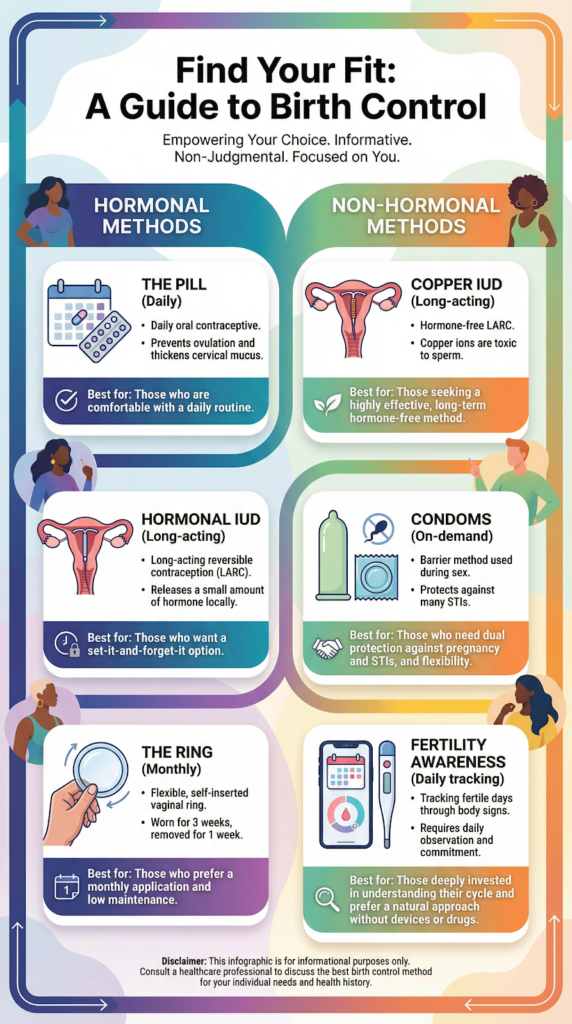
The Hormone Squad: Effective & Low-Maintenance
These methods are super popular because they’re incredibly effective and can even help with things like heavy periods and cramps.
The Superstars: IUDs & The Implant (aka LARCs)
If you’re looking for a “set it and forget it” option, these are your MVPs. LARCs (Long-Acting Reversible Contraceptives) are the most effective methods out there—we’re talking over 99% effective. [1]
- Hormonal IUDs (Mirena, Kyleena, etc.): A tiny, T-shaped device that a doctor places in your uterus. It releases a small amount of the hormone progestin to prevent pregnancy and can last for 3-8 years. Bonus: It often makes periods much lighter or even disappear altogether.
- The Implant (Nexplanon): A tiny, flexible rod that’s inserted under the skin of your upper arm. It releases progestin and protects you from pregnancy for up to 5 years.
Best for: Anyone who wants the most effective protection without having to think about it every day.
The Routine Crew: The Pill, Patch & Ring
These methods are also very effective, but they require you to remember to use them on a daily, weekly, or monthly basis. With perfect use, they’re great. With “typical” human use (because we all forget sometimes!), their effectiveness is closer to 93%. [1]
- The Pill: The classic. You take one pill every single day.
- The Patch: A sticker you wear on your skin that you change once a week.
- The Ring: A small, flexible ring you insert into your vagina for three weeks at a time.
Best for: People who are good with routines and want a method they can easily start and stop themselves.
The Hormone-Free Zone: For a More Natural Vibe
If you’d rather not use hormones, there are some fantastic and effective options for you, too.
The Copper IUD (Paragard)
This is the only hormone-free LARC, and it’s a powerhouse. It’s a small, T-shaped device wrapped in copper that a doctor places in your uterus. The copper creates an environment that’s toxic to sperm. It’s over 99% effective and can last for up to 10 years. The one downside? It can sometimes make periods heavier and more crampy, especially at first.
Best for: Someone who wants a super-effective, long-term, hormone-free method and doesn’t mind their natural period.
The On-Demand Defender: Condoms
Don’t sleep on the condom! It’s a classic for a reason. When used correctly every time, condoms are a great way to prevent pregnancy. But their biggest superpower is that they are the only method that also protects you from Sexually Transmitted Infections (STIs). Because of this, it’s a great idea to use condoms even if you’re on another form of birth control.
Best for: Everyone! Especially for STI protection, as a backup method, or if you’re not having sex regularly.
How to Choose Your Fighter: A Vibe Check
Feeling clearer? To narrow it down, ask yourself these questions:
- How important is effectiveness? If preventing pregnancy is your absolute top priority, a LARC like an IUD or the implant is your most reliable bet.
- Am I okay with hormones? Or would I prefer a hormone-free option?
- How much maintenance am I willing to do? Can I remember a pill every day, or do I need something I don’t have to think about?
- Do I need STI protection? If yes, condoms are your non-negotiable friend.
You’re in the Driver’s Seat
This guide is your starting point. The next step is to take this knowledge and have a conversation with a healthcare provider. They can talk to you about your personal health history and help you make the final choice.
Remember, you can always change your mind. What works for you now might not be what you need in a few years, and that’s totally okay. This is your body, your health, and your choice.
And if you choose a method that relies on understanding your cycle, like Fertility Awareness, an app like CrampCare can be an essential tool to help you track your signs with confidence. Knowledge is power, and you’ve got this.
References
[1] Centers for Disease Control and Prevention. (2023). Contraception. https://www.cdc.gov/reproductivehealth/contraception/index.htm