Whether you’re thinking about starting a family someday, or you’re very much not trying to get pregnant right now, understanding your own fertility is like having a superpower. It’s the key to making informed decisions about your body and your future.
But let’s be real: most of us weren’t taught how to do this. We learn that our period comes once a month, and that’s about it. The part in the middle—ovulation—is often a total mystery. When does it happen? How do I know?
At CrampCare, we believe that fertility education is for everyone. Knowing when you’re fertile gives you the power to either achieve or avoid pregnancy. Let’s pull back the curtain and learn how to decode your body’s secret signals.
First, What Is Ovulation & The Fertile Window?
In simple terms, ovulation is the main event of your menstrual cycle. It’s the moment when one of your ovaries releases a mature egg. This egg then travels down the fallopian tube, where it can be fertilized by sperm.
Here’s the catch: the egg only lives for about 12-24 hours. But sperm can live inside your body for up to 5 days! This means the time you can actually get pregnant—your fertile window—is about 6 days long. It includes the 5 days before ovulation and the day of ovulation itself.
Nailing down this 6-day window is the whole game. So, how do you find it? Your body actually leaves you clues. You just have to know what to look for.
Your Body’s 3 Big Ovulation Clues
Think of yourself as a detective and your body as the scene of the crime. There are three main clues you can track to find out when you’re ovulating.
Clue #1: Your Calendar (Cycle Tracking)
This is the most well-known method, but it comes with a big asterisk. The basic idea is to use the length of your past cycles to predict your future fertile window.
How it works: Ovulation typically happens about 14 days BEFORE your next period is due to start. This is a key point! It’s not 14 days after your last period ended.
- If you have a perfect 28-day cycle, you’ll likely ovulate around day 14.
- If you have a longer 32-day cycle, you’ll likely ovulate around day 18.
The catch: This method only gives you a rough estimate. It works best if your cycles are super regular. If your cycle length varies, the calendar method alone can be unreliable.
Clue #2: Your Cervical Mucus (Your Body’s Secret Signal)
This might sound a little weird, but checking your cervical mucus is one of the most reliable ways to spot your fertile window in real-time. This fluid changes throughout your cycle to either help or block sperm.
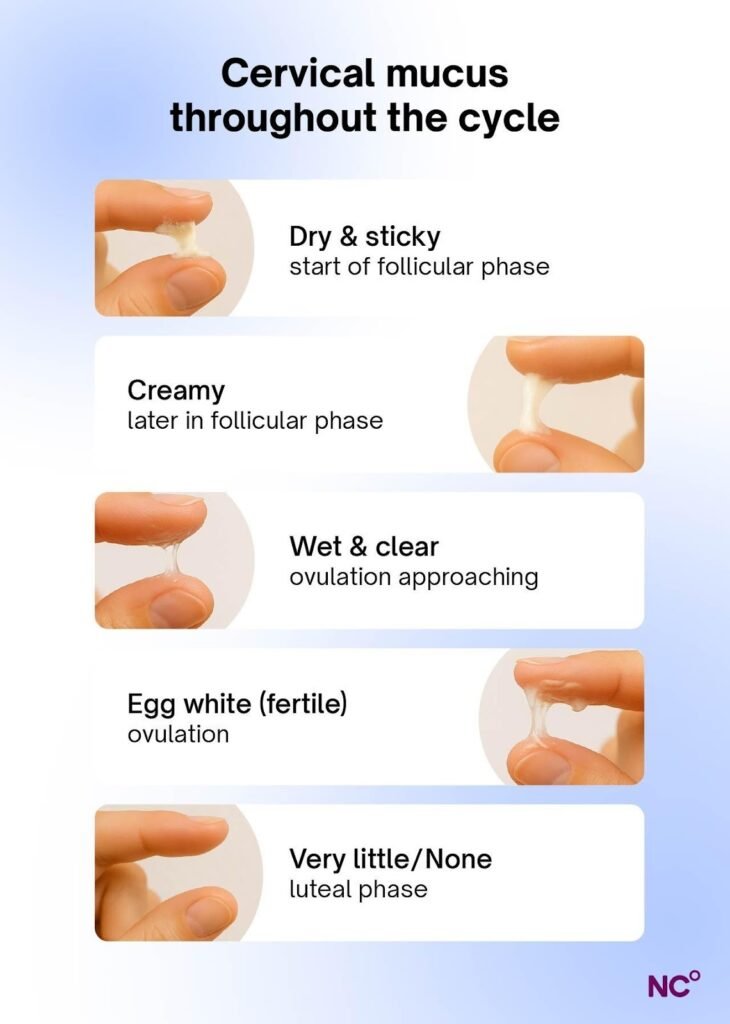
How it works: After your period, you’ll likely be dry for a few days. As you get closer to ovulation, your estrogen levels rise, and you’ll start to notice more mucus. It will go through a few stages:
- Sticky or Gummy: Like paste.
- Creamy or Lotion-y: White or yellowish, like hand lotion.
- Egg White (The Main Event!): Right before and during ovulation, your mucus will become clear, slippery, and super stretchy—just like raw egg whites. This is your body’s green light for fertility! This “egg white” mucus helps sperm swim and stay alive. [1]
Once you see egg white cervical mucus, you know you are in your fertile window.
Clue #3: Your Basal Body Temperature (BBT)
Your Basal Body Temperature (BBT) is your body’s temperature when you’re fully at rest. By tracking this temperature every morning, you can confirm when ovulation has already happened.
How it works: You’ll need a special BBT thermometer that measures in tiny increments. You must take your temperature at the exact same time every morning, before you even sit up in bed, talk, or check your phone.
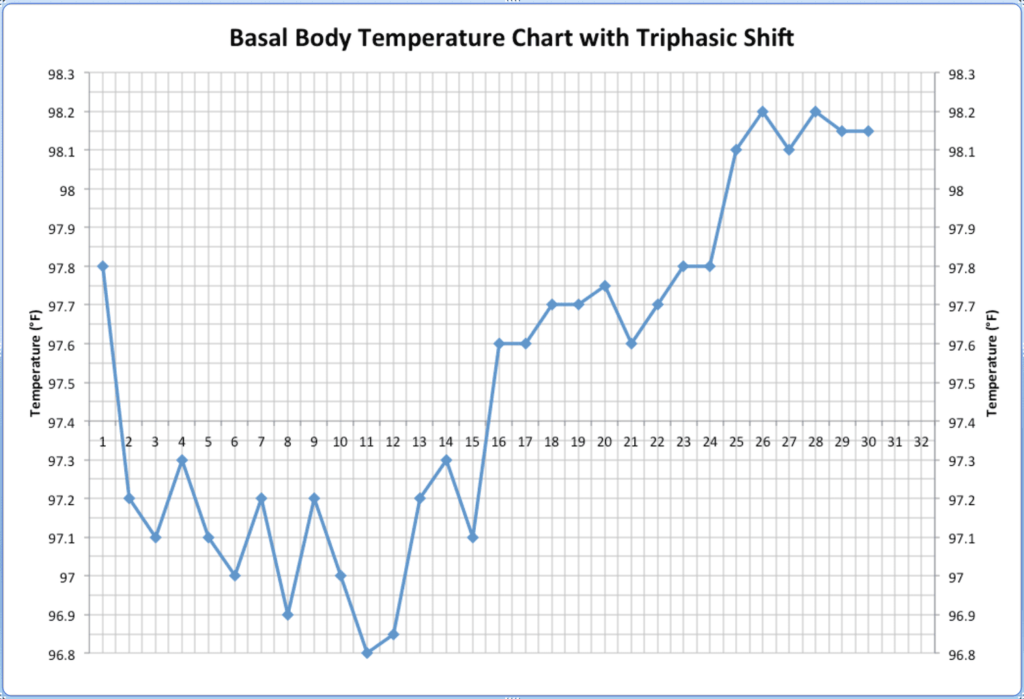
- In the first half of your cycle, your BBT will be relatively low.
- After you ovulate, the hormone progesterone causes your temperature to spike up by about 0.5 to 1.0 degrees Fahrenheit (about 0.3 to 0.6 degrees Celsius). It will stay elevated until your next period. [2]
The catch: BBT charting doesn’t predict ovulation in advance; it confirms it after the fact. This makes it more useful for understanding your cycle patterns over time or confirming if you ovulated, rather than for timing intercourse in the moment.
The Power Trio: Putting It All Together
While each of these methods gives you a piece of the puzzle, using them together is the most accurate way to pinpoint your fertile window.
- Your calendar gives you a heads-up for when to start paying closer attention.
- Your cervical mucus tells you in real-time when your fertile window has opened.
- Your BBT confirms that ovulation happened, helping you understand your cycle’s length and rhythm.
The Easy Button: Let CrampCare Do the Work
Feeling a little overwhelmed? That’s totally normal. Tracking all these signs can feel like a part-time job. But that’s where technology comes in.
Using an app like CrampCare simplifies everything. You can log your period dates, your cervical mucus consistency, and your daily BBT all in one place. The app’s algorithm does the heavy lifting, analyzing your unique data to give you a clear prediction of your fertile window and ovulation day.
It takes the guesswork out of the equation and turns you into the ultimate expert on your own body. Whether your goal is to get pregnant or prevent it, knowledge is power.
Ready to unlock your fertility superpower? Download CrampCare and start tracking your cycle with confidence today.
References
[1] American College of Obstetricians and Gynecologists. (2021). Fertility Awareness-Based Methods of Family Planning. https://www.acog.org/womens-health/faqs/fertility-awareness-based-methods-of-family-planning
[2] Ecochard, R., Duterque, O., Leiva, R., & Bouchard, T. (2015). Self-identification of the clinical fertile window and the ovulation period. Fertility and sterility, 103(5), 1319–1325.e3. https://doi.org/10.1016/j.fertnstert.2015.01.031